

Understanding Truck Accident Liability: More Complex Than You Might Think
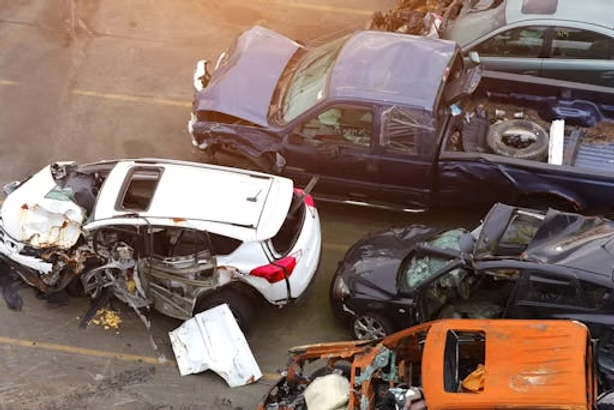
When a massive semi-truck collides with a passenger vehicle, the aftermath can be devastating and life-changing. If you’ve been involved in a truck accident in Virginia, identifying who’s legally responsible isn’t always straightforward. Unlike regular car accidents, semi-truck crashes often involve multiple potentially liable parties beyond just the driver.
This complex web of liability can significantly impact your ability to recover fair compensation for your injuries and damages. The consequences of these accidents are often severe—medical bills pile up, income is lost, and pain becomes a daily companion. Understanding who can be held accountable is the crucial first step toward securing the compensation you deserve.
If you’ve been tangled in the aftermath of a semi-truck accident, navigating the complex web of liability doesn’t have to feel like a solo journey. Let Altizer Law be the guiding light on your path to recovery. Pick up the phone and dial 540.345.2000, or take a moment to contact us online. Your peace of mind is just a call or click away.

Virginia’s Legal Framework for Truck Accident Liability
In Virginia, establishing liability in semi-truck accident cases requires understanding the principle of vicarious liability. This is a legal doctrine that’s particularly relevant in commercial vehicle accidents. Under this principle, when a semi-truck driver causes an accident while performing job duties, their employer (the trucking company) can be held responsible for the resulting injuries and damages. This is fundamentally different from standard passenger vehicle accidents, where liability typically stops with the driver. It’s essential to understand all of this when you’re seeking compensation after a semi-truck accident.
Commercial carriers operating in Virginia must comply with detailed federal and state safety regulations that don’t apply to regular drivers. These regulations create additional avenues for establishing negligence. Furthermore, commercial carriers typically carry much higher insurance coverage than private vehicles, which can be crucial when dealing with the catastrophic injuries often resulting from these accidents. Understanding these legal distinctions is essential to properly pursuing your claim and maximizing your potential compensation.
The Four Essential Elements to Prove Liability in Virginia Truck Accidents
Successfully establishing liability in a Virginia semi-truck accident case requires methodically proving four core elements. Each element builds upon the previous one, creating a complete picture of legal responsibility. What many accident victims don’t realize is that the investigation phase is often the most critical—and most time-sensitive—part of the process. Evidence such as electronic logging devices (black box data), maintenance records, and driver qualification files can disappear quickly if not properly preserved. Here’s what you need to establish:
-
Duty of Care: All drivers on Virginia roads, especially commercial drivers, have a legal duty to operate their vehicles safely. Commercial drivers are held to an even higher standard due to their professional training and the potential danger their vehicles pose.
-
Breach of Duty: You must demonstrate that the driver or another party failed to uphold their duty of care. This could involve violations of Federal Motor Carrier Safety Administration regulations, such as exceeding the 11-hour driving limit.
-
Causation: The breach of duty must be directly linked to the accident. This often requires accident reconstruction professionals to establish precisely how the accident occurred and how the defendant’s actions led to it.
-
Damages: You must provide evidence of the actual harm suffered, including medical expenses, lost wages, property damage, and non-economic damages like pain and suffering.
Navigating the Complex Web of Liability with Professional Legal Support
Resolving a semi-truck accident case in Virginia requires identifying all potentially liable parties to ensure full compensation. At Altizer Law, we conduct thorough investigations that often reveal multiple responsible parties beyond just the driver. Our experience with commercial vehicle accidents has shown that proper identification of all liable parties can significantly increase the compensation available to victims.
Virginia follows a contributory negligence rule, meaning if you’re found even 1% at fault, you could be barred from recovering damages—making professional legal representation crucial. Our approach involves preserving critical evidence immediately after an accident, including electronic control module data, driver logs, and maintenance records before they can be altered or destroyed. When multiple liable parties are identified, we strategically build cases against each one, ensuring every avenue for compensation is pursued while you focus on recovery.
Potential Liable Parties in Virginia Semi-Truck Accidents
Semi-truck accidents typically involve a more extensive range of potentially liable parties than regular passenger vehicle accidents. Understanding this broader scope is critical to ensuring you pursue compensation from all responsible entities. Each of these parties may have separate insurance policies and legal responsibilities, creating multiple avenues for recovery. However, each also comes with unique challenges in establishing liability. A comprehensive investigation is essential to uncover the full spectrum of responsible parties and build a compelling case against each one.
The Truck Driver and Trucking Company
The truck driver is often the most obvious liable party, especially if their negligence directly caused the accident. Typical forms of driver negligence include fatigue, distraction, impairment, speeding, or failing to adjust to road conditions. However, under the principle of vicarious liability, the trucking company can be held responsible for the driver’s actions when they occur within the “scope of employment.”
This is a critical factor in determining whether an employer bears responsibility for their employee’s actions. Additionally, trucking companies may be directly liable for their negligence in hiring, training, or supervision practices. For instance, if a company hired a driver with a history of safety violations or failed to enforce mandatory rest periods, it could be independently liable. We’ve found that thoroughly examining a trucking company’s hiring records often reveals patterns of negligent employment practices that can strengthen a victim’s claim substantially.
Secondary Parties That May Share Liability
Beyond the driver and trucking company, several other entities may bear responsibility for semi-truck accident cases. These secondary parties often play crucial but less prominent roles in contributing to the accident. Identifying these additional liable parties can be complex and typically requires knowledge of the commercial transportation industry. In many cases, these entities have separate insurance policies, potentially increasing the total compensation available to accident victims. A thorough investigation may reveal surprising connections between seemingly unrelated parties and the accident’s causes.
Cargo Loaders and Vehicle Maintenance Providers
Improperly loaded cargo can cause serious accidents by affecting a truck’s balance, braking capability, or causing cargo spills. The company responsible for loading the cargo—which may be different from the trucking company—can be liable if improper loading contributed to the accident. Similarly, maintenance providers play a critical role in ensuring commercial vehicles operate safely.
If poor maintenance—such as brake failures, tire blowouts, or steering malfunctions—contributed to the accident, the maintenance company may share liability. These cases often require analysis of maintenance records and inspection reports to establish the connection between maintenance failures and the accident. Evidence must be secured quickly, as maintenance records can be modified or destroyed if not preserved adequately through legal channels.
Vehicle and Parts Manufacturers’ Liability
When a defective truck component contributes to an accident, the manufacturer may be held liable under product liability laws. Unlike other forms of liability, product liability claims don’t necessarily require proving negligence—instead, you must demonstrate that the part was defective and that the defect contributed to the accident.
These cases often involve complex technical issues and require testimony from engineers or other professionals. Manufacturers typically have substantial resources to defend against such claims, making professional legal representation particularly important. Common defects include faulty brakes, tire defects, steering system failures, or defective coupling devices between tractors and trailers.
Government Entities and Road Maintenance Contractors
In some cases, dangerous road conditions contribute to semi-truck accidents. Poor road design, inadequate signage, missing guardrails, or improper maintenance may create hazardous conditions that increase accident risk. When this occurs, government entities responsible for road design and maintenance or private contractors hired for these tasks may share liability.
Claims against government entities involve procedures and shorter deadlines than standard personal injury claims. In Virginia, you typically have just 6 months to file a notice of claim against a government entity, compared to the standard 2-year statute of limitations for personal injury claims. These cases require careful investigation of road conditions at the time of the accident and thorough documentation of any hazards that may have contributed to the crash.
Shared Fault Scenarios in Virginia Truck Accidents
Many semi-truck accidents involve multiple contributing factors and potentially shared fault among several parties. These complex liability scenarios require careful investigation and strategic legal approaches. In Virginia, the stakes are particularly high due to the state’s contributory negligence rule. Understanding how fault might be distributed and how to protect your rights in these scenarios is essential to successful recovery. Each liable party may attempt to shift blame to others, making a comprehensive and coordinated legal strategy necessary.
Virginia’s Contributory Negligence Rule and Its Impact
Virginia follows a strict contributory negligence rule, which means if you’re found even slightly at fault for the accident, you may be barred from recovering any compensation. This makes establishing clear liability against other parties crucial. When multiple entities share fault for a truck accident, your attorney must build a case that demonstrates others’ responsibility while protecting you from allegations of contributory negligence.
Insurance companies representing trucking companies are well aware of this rule and often attempt to assign partial blame to accident victims to avoid paying claims. Having experienced legal representation becomes particularly important in these scenarios to counter such tactics and preserve your right to compensation.
Frequently Asked Questions
-
How does vicarious liability apply in Virginia semi-truck accident cases?
In Virginia, vicarious liability means a trucking company can be held responsible for accidents caused by its drivers when the driver is acting within the “scope of employment.” This legal principle applies when the driver is performing job-related duties at the time of the accident. For example, if a truck driver causes an accident while making a delivery, the trucking company can typically be held liable. However, if the driver was using the truck for personal errands outside work hours, vicarious liability might not apply. This principle is crucial in truck accident cases because it often allows victims to pursue claims against companies with substantial insurance coverage rather than just individual drivers.
-
What evidence is most important for establishing liability in a Roanoke truck collision case?
The most critical evidence in truck accident cases includes the truck’s electronic logging device (black box) data, which records speed, braking patterns, and hours of service; driver qualification files showing training and safety records; maintenance logs documenting vehicle upkeep; the driver’s logbooks tracking hours of service; post-accident drug and alcohol testing results; and witness statements. Additionally, securing the truck’s load manifests can help determine if improper loading contributed to the accident. This evidence must be secured quickly—sometimes within days of the accident—before it can be altered or destroyed. A Roanoke truck accident lawyer can send spoliation letters to preserve this evidence and may need to obtain court orders to ensure its protection.
-
Can I pursue a Virginia truck lawsuit if the accident involved a truck from another state?
Yes, you can pursue a lawsuit in Virginia even if the truck and trucking company are from another state. If the accident occurred in Virginia, the Virginia law typically applies to the case. This is important because it means Virginia’s contributory negligence rule would apply. You may have options regarding where to file your lawsuit—either in Virginia or potentially in the state where the trucking company is headquartered. Each option has strategic advantages and disadvantages. An experienced truck accident attorney can help determine the most advantageous jurisdiction for your specific case, considering factors like local laws, potential jury pools, and convenience.
-
How long do I have to file a truck liability claim in Roanoke?
In Virginia, including Roanoke, you generally have two years from the date of the accident to file a personal injury lawsuit for a truck accident. This is known as the statute of limitations. However, suppose you’re filing a claim against a government entity that may share liability (such as for poor road maintenance). In that case, you typically must file a notice of claim within six months. Missing these deadlines can permanently bar your right to compensation. Additionally, while two years might seem like ample time, the investigation of truck accidents is complex and time-sensitive. Critical evidence can disappear quickly, so it’s advisable to consult with an attorney as soon as possible after the accident.
-
How does insurance work in commercial vehicle accident cases in Virginia?
Commercial trucks typically carry much higher insurance coverage than passenger vehicles—often $750,000 to $1,000,000 or more, depending on the cargo. This higher coverage reflects the greater damage potential of these large vehicles. Unlike personal auto insurance claims, commercial truck insurance claims often involve multiple policies, including the trucking company’s primary liability policy, excess coverage policies, and potentially separate policies for the trailer or cargo. After paying a claim, insurance companies may attempt to reclaim money by pursuing other at-fault parties or their insurers through a process called subrogation. This complex insurance landscape makes professional legal representation particularly valuable, as attorneys experienced with truck accidents understand how to navigate these various policies to maximize your compensation.
Work with a Semi-Truck Injury Lawyer
Semi-truck accidents create legal challenges that far exceed those of typical vehicle crashes. The severity of injuries, complex liability questions, and substantial insurance policies demand knowledge and experience. A qualified semi-truck injury attorney will immediately begin preserving critical evidence, identifying all potentially liable parties, and calculating the full extent of your damages—including future medical needs and long-term impacts. They’ll handle communications with insurance companies while you focus on recovery, ensuring your rights are protected throughout the process.
When selecting an attorney, look for one with specific experience in commercial vehicle cases, knowledge of federal trucking regulations, access to qualified professionals, and a track record of successful settlements and verdicts in similar cases. Most truck accident attorneys offer free initial consultations and work on a contingency fee basis, meaning you pay nothing unless they secure compensation for you. Taking this critical step can make a significant difference in the outcome of your case and your ability to rebuild your life after a serious truck accident.
Riding the wave of complexity in truck accident liability? Let Altizer Law alleviate your worries with straightforward legal support. Reach out at 540.345.2000 or contact us today to steer your case toward a promising resolutio